Dr Jayesh Amin

Dr Jayesh Amin

Advanced Reproductive Age and Fertility: What Every Couple Should Know

In today’s world, many couples plan their pregnancy later in life usually after 35-38 years, because of higher education, professional goals, financial planning or finding the right partner. While this shift is completely understandable, increasingly common and acceptable, it is also important to understand that in such scenario how advanced reproductive age may affect fertility potential and future pregnancy outcomes. Advanced Reproductive Age and Fertility: What Every Couple Should Know is essential information for anyone considering delaying pregnancy.

Medically, advanced reproductive age is considered to be above 35 years and the impact on fertility becomes more significant after 37–38 years of age. This does not mean that pregnancy is impossible, but it means that fertility gradually declines and certain risks increase, which is a matter of concern.

The most important factor with age-related fertility decline is the falling number and quality of eggs present in the ovaries. Women are born with a fixed number of eggs and this ovarian reserve decreases naturally with the age and time. Importantly, egg quality reduces with age. This affects fertilization, embryo developmental potential and implantation rate. As a result, it may cause further delay in conception when the couple wants to conceive and the chances of miscarriages also increase.

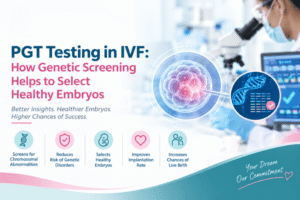
Another aspect to consider is the rise in chromosomal abnormalities in the developing embryo when conception occurs in advancing age. This can lead to conditions like Down’s syndrome or early pregnancy loss. Because of this, women in their late 30s or 40s are usually advised additional prenatal screening or genetic testing of embryo during their journey.

If this declining fertility due to advancing age further gets superimposed by uterine pathologies like fibroid or adenomyosis and endocrinal disturbances or other co- morbid conditions; then it further becomes difficult for the couple. Lifestyle factors such as stress, weight fluctuations, thyroid issues or metabolic disorders can further influence fertility outcomes in this age group.

However, it is equally important to emphasize that many women above 35 and even 40 can conceive successfully, either naturally or with medical support and proper guidance and treatment strategy. Modern reproductive medicine and science offers several effective options and hope to improve the chances of conception and successful ongoing pregnancy for this group of couples. Timely evaluation is the key.

If a woman above 35 is trying to conceive, couple should consider fertility assessment if pregnancy does not occur within 6 months of regular attempts. The evaluation may include ovarian reserve testing such as AMH levels, ultrasound to look for antral follicle count in ovaries and partner’s semen analysis. Early testing helps in designing the most suitable approach without losing valuable time.

Depending on the reports, treatment options may range from lifestyle modifications to ovulation optimization to assisted reproductive techniques such as IUI or IVF. For some couples, advanced techniques like genetic testing of embryos or fertility preservation strategies may also be discussed.

Awareness and timely consultation are more powerful than delayed intervention. For females, who do not wish to plan pregnancy at present, but wish to keep the option open ; egg freezing at a younger age is a useful fertility preservation strategy. This allows better reproductive potential and results in future compared to attempting for conception with significantly aged eggs.

This message is to promote informed decisions and choices. Fertility issue is deeply personal and every woman’s journey is unique. However, Understanding how age influences reproductive health helps couples plan their family wisely, seek help early and fulfill their dream of parenthood as per their terms.

If you or someone you know is planning pregnancy later in life, remember:
Awareness, correct medical guidance and timely evaluation can make a big difference.


📞 To schedule a consultation with Dr. Jayesh Amin in Ahmedabad, please book your appointment today.

Frequently Asked Questions

Ahmedabad is now home to one of India’s leading IVF doctors, offering advanced reproductive science with personalised care. Dr. Jayesh Amin combines world-class fertility expertise with ethical, transparent treatment protocols that have helped thousands of couples conceive.

Failed cycles don’t mean the end. Dr Amin specialises in improving success rates after previously failed IVF by identifying root-cause issues. We see at least two couples every day who come in after being told that donor eggs or sperm are the only option left. In most cases, that is not true. Before considering donation, we study why previous cycles did not work, including stimulation pattern, embryo growth, uterine health, and timing.

Yes — couples across India and abroad consult online with our fertility expert to review reports and receive a personalised plan. This allows you to get expert guidance from Dr. Jayesh Amin regardless of your location.

Yes, we provide egg freezing treatment in Ahmedabad with evidence-based protocols and transparent care. Our centre offers safe, evidence-driven egg freezing using protocols designed to optimise egg quality with minimal discomfort. Many women across India choose Dr Amin’s clinic as a trusted egg freezing centre for medical, career, or personal reasons.

Many couples are told they need other options. With the right diagnostics and timing, that’s often not the case. Our goal is simple: conception with your own genetics whenever science allows.

Reports show numbers. Biology shows behavior. Even when everything appears fine, subtle differences in timing, hormonal response, or embryo development can influence results. Each failed cycle provides information. When that data is reviewed properly, the next plan is sharper and more targeted.

Dr. Amin believes every couple deserves the chance to have a baby that is genetically their own. Age alone does not decide outcome. What matters is how the ovaries respond, how embryos develop, and how the body supports implantation. Many women above 37 still conceive using their own eggs once the process is optimized. Donor is considered only when truly necessary.

We do not just repeat treatment. We study it. Every cycle is reviewed in depth to understand what worked, what did not, and why. The next plan is then built around your body’s specific response, not a generic formula.

Genetic testing (PGT-A) examines embryos for chromosomal balance before transfer. It is advised in cases like repeated IVF failures, recurrent miscarriages, or when one partner carries a known genetic condition. It helps improve the chance of a healthy pregnancy and reduces the likelihood of loss.

Genetic testing (PGT-A) examines embryos for chromosomal balance before transfer. It is advised in cases like repeated IVF failures, recurrent miscarriages, or when one partner carries a known genetic condition. It helps improve the chance of a healthy pregnancy and reduces the likelihood of loss.

We see at least two couples every day who come in after being told the same thing, that donor eggs or sperm are the only option left. In most cases, that is not true. Before considering donation, we study why previous cycles did not work, including stimulation pattern, embryo growth, uterine health, and timing. Once those are corrected, many couples go on to conceive with their own eggs and sperm. Donor options are used only when there is a clear, proven medical reason, never as the first solution.

The first step is a detailed case review. We go through previous reports, stimulation charts, embryo grading, and transfer history. This helps identify patterns and possible gaps, giving us the clarity to plan differently, not just try again.

For most couples, it takes two to three attempts. Each cycle teaches something valuable about how the body responds to medication and timing. When that learning is applied, success rates rise steadily.

Complex simply means the reason for failure is not clear through standard testing. These cases often require deeper evaluation, such as hormonal balance, uterine environment, and sometimes genetic factors. With the right assessment, even complex cases can become manageable.

Yes. Many of our patients travel from across India and abroad. We offer structured out-of-town care plans that include pre-visit consultations, coordination with your local doctors, and tie-ups with 3-, 4-, and 5-star hotels for comfortable stays. From arrival to treatment to follow-up, everything can be planned in advance so your journey remains smooth and stress-free.

Choose based on clarity, not claims. Ask how they review past failures, how decisions are explained, and how they determine when donor options are truly necessary. Even if you do not go ahead with Dr. Amin, make sure your doctor walks you through the why behind every step, not just the what. A safe fertility journey is one where you understand your plan, your risks, and your options clearly and calmly. That clarity alone can change outcomes.